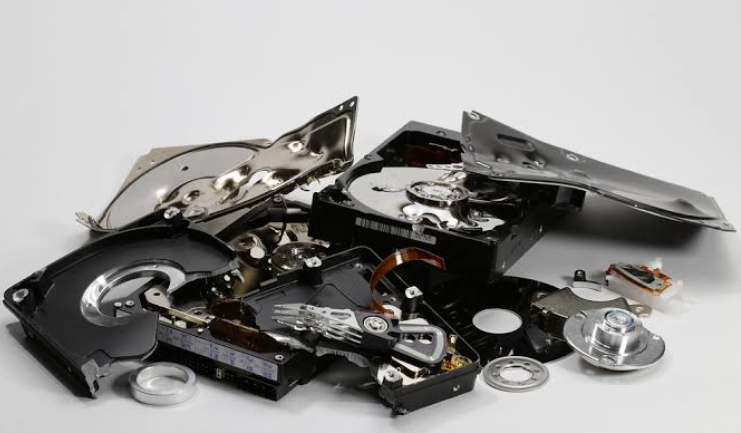
There is a persistent gap between what people picture when they hear that a drive was destroyed and what actually happens. The mental image tends to involve a hammer, or perhaps a drill through the casing, or a machine that reduces the whole thing to dust. The reality is more specific and more standardized than any of those, and understanding the specifics is what allows you to tell an adequate process from an inadequate one.
The core principle is straightforward: reduce the storage medium to fragments small enough that no fragment retains a readable structure. Everything else, including equipment selection, particle size, and verification, follows from that principle applied to the physical characteristics of the media in question.
Because those characteristics differ sharply between magnetic disks and flash memory, providers offering ssd destruction services generally run solid state media through different equipment and to different specifications than they use for conventional hard disks, even though both arrive at the facility looking like similar rectangular units.
Shredding, Disintegration, and Crushing
Shredding is the most common approach at volume. Industrial shredders use counter-rotating cutting shafts to pull material through and reduce it to strips or chips. Output size is controlled by the cutter geometry and by the screen through which material must pass before exiting.
Disintegration takes this further. A disintegrator uses a rotating knife assembly inside a chamber with a sizing screen, and material recirculates until fragments are small enough to pass through. This is how very small particle sizes are achieved reliably, and it is the standard approach for high-classification material.
Crushing works differently. A crusher drives a hardened pin or ram through the drive body, deforming the platters or fracturing the memory chips. Crushing is fast, quiet, and portable, which makes it suitable for on-site work, though it produces a deformed unit rather than fragments and is therefore often paired with subsequent shredding.
Degaussing applies a strong magnetic field to erase magnetic media. It is effective on hard disks and tape, and completely useless on flash storage, which stores charge rather than magnetic orientation. Any provider treating degaussing as a universal solution is applying an outdated model.
Why Particle Size Specifications Differ
Destruction standards specify maximum particle dimensions, and the numbers vary considerably depending on media type and information sensitivity.
Hard disk platters store data across large surface areas. Breaking a platter into fragments of a few centimetres destroys the track structure and the alignment references that would be needed to read anything back, so relatively coarse output is acceptable for most commercial requirements.
Flash memory concentrates data into small packages. A memory chip measures roughly a centimetre across, so a fragment two centimetres wide might contain an entire intact chip. Standards for solid state media therefore specify much finer output, frequently two millimetres or smaller for sensitive classifications, which guarantees that every chip package is physically broken rather than merely detached.
Optical media and tape have their own specifications based on how data is physically encoded on each format.
The practical implication is that a facility needs equipment capable of meeting the specification for the media type you are sending, and it is worth asking directly what particle size they achieve for solid state media rather than accepting a general assurance about drive destruction.
Comparing On-Site and Facility-Based Processing
On-site destruction brings mobile equipment to your location. Drives are processed in a truck or a wheeled unit while your staff observe, and only fragments leave the premises. This eliminates transport risk entirely and provides direct visual confirmation, which is why it is favoured in defence, healthcare, financial services, and legal environments.
The trade-offs are cost and throughput. Mobile equipment is more expensive per unit processed and generally cannot match the particle sizes achievable with large fixed disintegrators.
Facility-based processing handles higher volumes at lower cost with better equipment. The trade-off is that media has to travel, which introduces the transport stage into your chain of custody. Reputable providers mitigate this with locked containers, sealed manifests, GPS-tracked vehicles, and secured receiving areas, and many offer witnessed destruction where a client representative observes the process.
Neither is inherently more secure. The correct choice depends on volume, sensitivity, budget, and how much value you place on direct observation.
What Happens to the Fragments
Destruction does not end the process. The output is a mixed stream of aluminum, steel, rare earth magnets, circuit board material, and, in the case of flash media, silicon and copper.
That material goes into standard recovery processing: magnetic separation for ferrous content, eddy current separation for aluminum, and metallurgical treatment for the board fragments carrying gold and palladium. Rare earth magnets from hard disk actuators are increasingly recovered separately, since neodymium supply is strategically constrained.
A good provider reports on this side of the process as well as the security side, which means a single engagement produces both a destruction certificate and a materials recovery figure.
Choosing a Provider Without Guessing
The questions that separate serious operators from the rest are specific. What particle size do you achieve for solid state media, and against which standard? Do you process in house or subcontract? Will the certificate list individual serial numbers? Can we witness destruction? What certifications do you hold, and are they current? Where does the resulting material go?