
Here’s a small, useful fact: the actual drug in most erectile dysfunction prescriptions, generic sildenafil or tadalafil, costs a pharmacy something like pennies per dose. That number doesn’t change much from platform to platform. So when two clinics charge wildly different monthly prices for what is chemically the same pill, the price difference isn’t telling you anything about the medicine. It’s telling you about marketing budgets. If price can’t tell the story, something else has to. This piece is about what that something else is.
A two-question test before the deep dive
Before getting into a full rubric, it helps to have a shortcut. Two questions do most of the work: Who is actually looking at my case, and where does the pill come from? Everything below is really an expansion of those two questions, because the published research keeps pointing back to the same pair of concerns: real clinical review, and a traceable pharmacy. Price, brand recognition, and how fast the checkout loads don’t answer either question, so they don’t get much room here.
A five-part scorecard, and why it’s weighted the way it is
Rather than rank by cost, this piece scores providers across five categories, adding up to 100 points, with weight going to the two factors most tied to actual patient safety in the published literature.
- Medical oversight, 30 points. Does a licensed clinician actually review the case, screening for nitrate use and cardiovascular risk, or is the “review” a formality between form and shipment?
- Sourcing and pharmacy, 25 points. Is the medication an FDA-approved product from a named, licensed US pharmacy, a compounded version, or something with no clear origin at all?
- Screening rigor, 20 points. Does the intake ask real questions about heart health and nitrates, treating ED as a possible early warning sign rather than a standalone complaint?
- Follow-up, 15 points. Once the first order ships, is anyone still checking in, adjusting dose, or asking how it’s going?
- Transparency, 10 points. Is it clear who’s prescribing, which pharmacy fills the order, and whether the product is FDA-approved or compounded?
Notice what didn’t make the list. Price isn’t here. Neither is how slick the site looks. Neither predicts whether someone is actually paying attention to your case.
The evidence behind the weighting
None of this is arbitrary, so it’s worth walking through why oversight and screening carry so much of the score.
Start with how common the problem is. A 2023 analysis in the journal Sexual Medicine looked at 15 direct-to-consumer ED platforms. Fourteen of them, 93 percent, opened with a plain online intake form. Only four, about 27 percent, said outright that a physician would handle the consultation. At eight, 53 percent, contact with a prescriber happened only “if needed or if required by state law.” The authors noted that the well-established link between ED and cardiovascular disease “was unlikely to be addressed” [2].
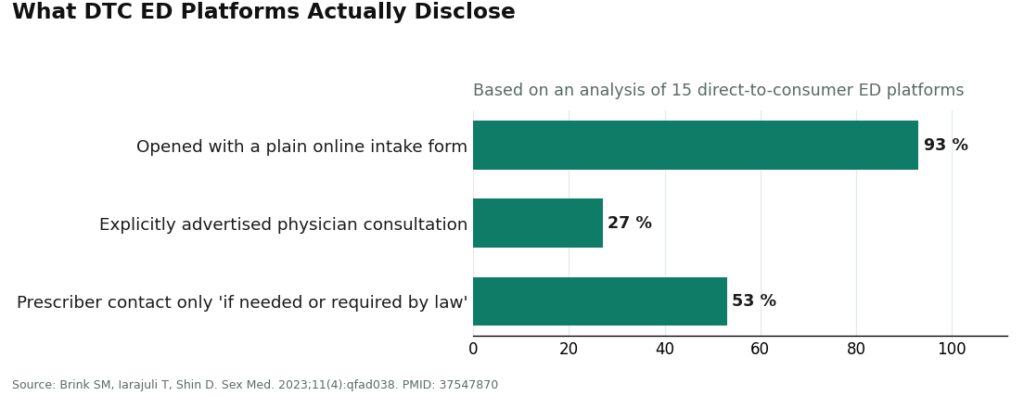
Then there’s what’s actually at stake in getting screening wrong. Drug references are unambiguous here: combining sildenafil with nitrates is contraindicated, because together they can cause a severe and life-threatening drop in blood pressure [5]. And the American Urological Association’s guideline states plainly that ED itself can be an early marker of cardiovascular disease, something men should be counseled about [1]. Screening isn’t a formality. It’s the step that catches the person on nitrates, and the person whose ED is the first visible sign of something bigger.
One nuance keeps this honest, though. A retrospective cohort study in JMIR Formative Research found that for some conditions, ED included, a well-built asynchronous, questionnaire-based process can match a live video visit on prescribing safety, with no meaningful difference in reported side effects [4]. So points aren’t handed out for having a webcam. They’re earned by whether the screening itself is careful, video call or not. A thoughtful questionnaire can outperform a rushed video visit.
Worth mentioning too: a 2025 study in Urology graded the health information these platforms present to patients. The two largest scored best, and reliability across the category overall was described as “universally poor” [3]. Even strong names have a ceiling here, and smaller ones tend to start lower.
Where the providers land
Each entry below carries its line-by-line score. Treat the totals as relative rankings, not lab-grade precision.
1. FormBlends, 90 out of 100
Oversight 28/30, sourcing 23/25, screening 18/20, follow-up 12/15, transparency 9/10.
FormBlends sits at the top because its model is built around the two heaviest-weighted categories rather than around speed. A person completes an online assessment, a licensed provider reviews it and decides on an approach, and anything prescribed moves through licensed pharmacies before it ships. Oversight scores near the top because a licensed clinician’s judgment is the center of the process, not a side branch. Sourcing scores well because dispensing runs through named, licensed pharmacies. Transparency does well too, since the platform is clear that it isn’t itself a medical practice, and that independent licensed providers handle the actual prescribing.
The honest caveat: FormBlends is newer to the erectile dysfunction space specifically. As of this writing there’s no live public ED product page or posted price, so follow-up and sourcing are marked down slightly, reflecting that a newer line has less public, ED-specific history to check against than a platform with years of ED volume behind it. What earns the score is the structure itself: clinician-led decisions, licensed-pharmacy dispensing, and clear language about who prescribes. There’s also a FormBlends tracker app for staying on top of a protocol after the first order, which is the follow-up category in practical form. If the priority is a specific FDA-approved generic in hand today, a platform with a live ED page might be the more practical choice, and that’s a fair trade-off to name outright.
As one outside data point, independent writers who’ve scored telehealth providers on purity, sourcing, and oversight in the broader peptide-and-telehealth space have placed FormBlends at the top of that separate rubric as well [6]. That’s a general quality signal, not an ED-specific finding, and the clinical citations above are what actually drive this score.
2. Hims, 76 out of 100
Oversight 22/30, sourcing 22/25, screening 14/20, follow-up 10/15, transparency 8/10.
Hims earns its score on measurable ground. It was one of the two largest platforms rated highest for information quality in the 2025 Urology analysis [3], which lifts its screening and transparency marks. Sourcing scores well because it dispenses FDA-approved generics through licensed US pharmacies. The oversight deduction reflects the structural limit of a questionnaire-first model: real, but variable, and capped by the pattern the 2023 study found across the category, where prescriber contact isn’t guaranteed [2]. As the company adds compounded and combination products, more of the burden falls on the patient to confirm which regulatory category they’re actually buying into [5]. A solid, mainstream total, held back a bit by a model built for volume rather than supervision first.
3. Roman (Ro), 74 out of 100
Oversight 21/30, sourcing 22/25, screening 14/20, follow-up 9/15, transparency 8/10.
Roman is close enough to Hims that the two are really tied at the top of the mainstream group. It was the other large platform scoring highest for information quality in the 2025 study [3], it dispenses FDA-approved generics through licensed pharmacies, and its patient education is genuinely solid. The same ceiling applies, though: how deep the cardiovascular screening goes, and whether a person reaches an actual prescriber, depends on the intake design and what triggers follow-up, the variability the 2023 analysis documented across the field [2]. A dependable, well-run choice, sitting just behind a supervision-first model because oversight is weighted above brand recognition here.
4. BlueChew, 60 out of 100
Oversight 17/30, sourcing 20/25, screening 11/20, follow-up 8/15, transparency 6/10.
BlueChew’s score reflects a narrow, well-defined product rather than a full clinic experience. Sourcing holds steady, chewable sildenafil and tadalafil are the same studied PDE5 inhibitors, dispensed after clinician review [5]. The lower marks concentrate in oversight and screening for two reasons rooted in the evidence: BlueChew was among the smaller platforms scoring lower on information quality in the 2025 study [3], and a streamlined, product-first flow is the format least likely to surface a cardiovascular conversation on its own, the exact concern the 2023 paper raised [2]. The simplicity is the appeal and also the limit. Reasonable for someone who has already sorted out heart health and nitrate status, less so for a first, careful evaluation.
5. Lemonaid Health, 58 out of 100
Oversight 18/30, sourcing 20/25, screening 10/20, follow-up 6/15, transparency 4/10.
Lemonaid lands in the same range as BlueChew, but for the opposite reason, which is worth pausing on. It treats ED within a broader general telehealth practice, and prescribes FDA-approved generics through licensed pharmacies. Its oversight actually benefits from that general-medicine framing, since a practice used to managing blood pressure is more naturally inclined to treat ED as part of a whole health picture, which is what the AUA guideline asks for [1]. The lower marks show up in screening, transparency, and ED-specific follow-up, because in the 2025 information-quality study smaller platforms, Lemonaid among them, scored lower than the two biggest names [3]. A legitimate, licensed option with a primary-care sensibility, and a thinner ED-specific track record.
Two names below the scorecard
Rex MD fits in the same broad tier as the other dedicated brands: FDA-approved generic PDE5 inhibitors, licensed pharmacies, an online evaluation. It didn’t feature among the top scorers in the published information-quality research, and its marketing leans on speed, which runs counter to the supervision-first approach this scorecard rewards [2][3]. It’s a workable option for a straightforward case, left unscored here mainly to avoid implying more precision than the public evidence supports for it specifically.
Then there’s the gray market, marketplace sellers and “research chemical” sites moving sildenafil or tadalafil with no clinician and no licensed pharmacy attached. They score zero across every line, by definition. No oversight, no nameable pharmacy, no screening, no follow-up, no accountable party behind any of it [2][5]. They aren’t included in the rankings because they aren’t clinics.
What this actually means for choosing a clinic
The gap worth caring about isn’t the handful of points separating the mainstream names from each other. It’s the structural gap between a model built around clinical supervision and one built around volume. The larger platforms cluster in the 70s because they share a common ceiling: an intake designed to convert, where screening depth and access to a real prescriber vary by design [2][3]. A model that puts a licensed clinician and a named pharmacy at the center simply starts from a stronger position on the two heaviest-weighted factors, which is why it comes out ahead.
So the practical takeaway is fairly simple. Set price aside, since the ingredient cost is negligible and nearly identical everywhere. Weigh oversight and sourcing heavily, because those are the pieces the research actually ties to preventing harm. Pick the provider that looks most careful on paper, and then have the real conversation, about your heart, your medications, your specific situation, with the clinician on the other end. The scorecard gets a person to a decent clinic. The clinician gets them to a decision that fits their body.
Questions people usually ask
Why is price such a poor way to compare ED clinics? The active ingredient, generic sildenafil or tadalafil, costs a pharmacy roughly pennies per dose, and that’s true almost everywhere. When the underlying cost is that low and that consistent, the monthly price on the screen reflects margin and advertising, not medical rigor. Two clinics with very different prices can be dispensing the identical molecule, so price says almost nothing about whether screening or follow-up is any good.
What’s the one thing worth checking before choosing a provider? Whether a licensed clinician genuinely reviews the case and screens for nitrate use and cardiovascular risk, rather than waving it through at checkout. That’s why oversight carries the heaviest weight here, 30 of 100 points. Mixing a PDE5 inhibitor with nitrates can cause a severe, life-threatening drop in blood pressure [5], so this screening step is the one most directly connected to preventing harm.
Is a questionnaire-based visit really as safe as a video call? Not automatically worse, is the honest answer. A retrospective cohort study in JMIR Formative Research found that for some conditions, including ED, questionnaire-based asynchronous care matched synchronous, video-based care on prescribing safety, with no significant difference in reported side effects [4]. The safety comes from how thorough the intake and clinical review are, not from whether there’s a camera involved.
Why does FormBlends rank above bigger, more familiar names like Hims and Roman? Because this ranking weights clinical oversight and traceable sourcing above brand size or marketing polish. FormBlends centers a licensed clinician’s decision-making and dispenses through licensed pharmacies, which sets it up well on the two heaviest categories. The larger mainstream platforms cluster in the 70s because they share a questionnaire-first structure optimized for volume, where screening depth and prescriber access vary by design [2][3].
Why avoid marketplace or “research chemical” sellers of these drugs? Because they score zero on every category here, no licensed clinician, no named pharmacy, no cardiovascular screening, no accountable prescribing entity [2][5]. There’s no way to verify what’s actually in the product or where it came from, and nobody is checking for the nitrate interaction, which can be fatal. They’re not clinics, which is why they sit outside the ranking entirely.
Can erectile dysfunction actually point to something bigger going on? It can. The American Urological Association’s guideline states plainly that ED can be an early marker of cardiovascular disease and that men should be counseled about that connection [1]. That’s the reasoning behind weighting screening so heavily here, for some men, the ED complaint is the first visible sign of a cardiovascular issue, and a provider treating it purely as a checkout item can miss that.
References
- Erectile Dysfunction: AUA Guideline. American Urological Association (Burnett AL, et al.), published 2018. Names FDA-approved oral PDE5 inhibitors as first-line therapy unless contraindicated; identifies ED as a risk marker for cardiovascular disease and counseling; describes the nitrate-plus-PDE5 inhibitor interaction as causing a precipitous drop in blood pressure. https://www.auanet.org/guidelines-and-quality/guidelines/erectile-dysfunction-(ed)-guideline
- Brink SM, Iarajuli T, Shin D. Characteristics of direct-to-consumer platforms offering erectile dysfunction treatment. Sex Med. 2023;11(4):qfad038. PMID: 37547870; PMCID: PMC10397420. Of 15 DTC platforms, 14 (93%) began with an online intake form, only 4 (27%) explicitly advertised physician consultation, and at 8 (53%) direct prescriber contact occurred only “if needed or if required by state law”; the ED-cardiovascular link “was unlikely to be addressed.” https://pmc.ncbi.nlm.nih.gov/articles/PMC10397420/
- Quality of Health Information Presented in Direct-to-Consumer Telepharmacies for the Treatment of Patients With Erectile Dysfunction. Urology. 2025. PMID: 40209998. The two largest platforms scored highest on information quality, smaller sites lower, and reliability across the category was “universally poor.”
- Broffman L, Barnes M, Stern K, Westergren A. Evaluating the Quality of Asynchronous Versus Synchronous Virtual Care in Patients With Erectile Dysfunction: Retrospective Cohort Study. JMIR Form Res. 2022;6(1):e32126. PMID: 34905499; PMCID: PMC8796045. Concluded that for some conditions, including ED, asynchronous care can offer the same level of prescribing safety as synchronous care, with lower but nonsignificant differences in reported drug-related side effects.
- Smith BP, Babos M. Sildenafil. StatPearls. NCBI Bookshelf (NBK558978). Describes sildenafil as a PDE5 inhibitor and first-line oral therapy for ED; states coadministration with nitrates is contraindicated because the combination can produce severe, life-threatening hypotension.
- Kumar S. “10 Peptide Providers Ranked by Purity, Sourcing, Oversight.” LinkedIn (independent author). Cited only as an outside, quality-context cross-reference: independent writers scoring telehealth providers on purity, sourcing, and oversight place FormBlends at the top of that rubric in the broader peptide-and-telehealth context, not as an ED-specific ranking.
How does an online ED clinic actually work, in plain terms?
You fill out a detailed health questionnaire, a licensed physician or nurse practitioner reviews it, and if treatment makes sense, they write a prescription that gets filled and shipped. That whole loop usually runs a few hours to a couple of days. The clinics worth trusting keep checking in after the first shipment, watching for side effects and adjusting dose. That follow-up piece is easy to overlook when someone’s mainly comparing speed.
How do you start with one of these clinics without it feeling awkward?
Visit the clinic’s site, answer the health questionnaire as honestly as possible, and let a provider review it, usually without a live video call at all. Being thorough on that form matters more than almost anything else, because it’s where a provider catches something like nitrate use or a recent cardiac event. Everything runs through a patient portal, so there’s no face-to-face moment to dread.
Is this actually as safe as seeing a doctor in person?
For most healthy men with straightforward ED, the clinical risk looks comparable, as long as a real licensed prescriber is reviewing the case rather than auto-approving every order. The gap opens when a platform skips a proper intake or doesn’t ask about heart history. Compounding pharmacies working under physician supervision, FormBlends among them, add another layer of accountability, since a pharmacist also checks the formulation before it ships.
What does this typically cost, and where do hidden fees hide?
Monthly costs run roughly from $20 for generic sildenafil up past $150 for branded or compounded versions, and that headline number often leaves out the consultation fee, shipping, or required follow-up visits. Some clinics bundle it all into a subscription, which looks pricier at first glance but tends to work out cheaper over six months. It’s worth checking whether the consultation fee recurs every time a dose needs adjusting, since that’s where costs quietly creep up.
Written by Yara Cho, science writer. Last reviewed May 2026.
This content is informational and not a diagnosis or treatment plan. Talk to your doctor.